
Most live service games lose 80 to 99 percent of their players within months due to The Collapse Stack. Pareto clustering, phase transitions, and influencer amplification. This article breaks down the math, historical collapses, and delivers practical strategies for building lasting communities.
The Math That Kills Games
Most big live service launches follow the same script in 2026: massive hype, record player counts for a few weeks, then silence. Data from 2025 and early 2026 releases shows the brutal reality. Most titles lost 80 to 99 percent of their peak players within months. Highguard launched to a Steam peak of 97,249 concurrent players only to lose over 99% before its servers were permanently shut down just 45 days later. The same cliff happened to 2025 releases like Supervive (retained under 1%), FragPunk (under 2%), and Mecha Break (under 3%). Up to 60 percent of players in live service games go inactive by month three.
Most games do not slowly decline. They fall off a cliff.
It’s rarely just bad updates or burnout. It is deeper. Virtual worlds are mirrors of real world human societies, governed by unbreakable mathematical laws. Power and population cluster in predictable ways. Tiny triggers cause sudden total collapses. And modern publishers are accidentally supercharging the problem by feeding the same small group of influencers and streamers. This creates an elite content class that turns hype into hate overnight on X.
Here is why games trend down, what the math actually says, and most importantly exactly what companies can do to build lasting communities instead of ghost towns.

The Invisible Math: Pareto Clustering + Phase Transitions
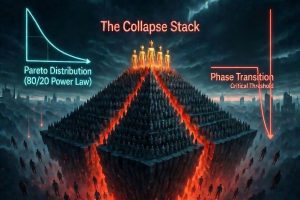
Every dying game follows the same system. I call it the Collapse Stack.
Two concepts from physics and economics explain almost every player exodus:
1. Pareto Distribution (Power Laws) In every virtual world, a tiny minority hoards most of the power, wealth, influence, and social capital. Think the classic 80 to 20 rule but often more extreme (top 1 to 5 percent controlling 80 percent plus). Guild sizes follow it: most stay small (around 60 players optimal); giants over 150 are rare. Wealth and gear in MMOs mirror real world inequality (Gini coefficients around 0.65 in studied virtual economies). Early joiners snowball advantages; latecomers grind for scraps. Even chat activity, raid spots, and economy control cluster the same way. The bottom 80 to 95 percent of players slowly feel like background NPCs. They do not rage quit immediately. They just stop logging in.
If players feel like background characters, they stop showing up.
2. Phase Transitions Systems look stable until one variable crosses an invisible line then everything flips overnight (like water freezing or a bridge collapsing). In games, this happens when population density or social connectivity drops below a critical threshold. Interactions dry up. Loneliness feedback loop leads to avalanche of quits. One bad patch, exploit, or drama event is the spark.
Collapse does not feel gradual from the inside. It feels instant.
Players do not just get bored. They build societies that override developer plans, then the math takes over.
Historical Proof: Three Legendary Collapses
- The Plague That Shut Down Cities (2005)
- The Feudal Pyramid Trap
- The Virtual Economy Meltdown (2006 to 2008)
These are not isolated bugs. They are what happens when human organization meets math at scale.
If that sounds extreme, look at modern launches. Games that go from millions of players to empty matchmaking queues in under a month. The pattern has not changed. Only the speed has.
The Modern Amplifier: Publisher Favored Influencers Create Instant Elites
Today publishers pour early access, review keys, and marketing budgets into the same YouTubers, streamers, and influencers. These creators pump out guides, meta breakdowns, and hype videos before anyone else can even play. In a world where everyone is a content creator, this gives a tiny group a massive head start.
Result? A supercharged Pareto layer on top of the in game one:
Top 1 percent of creators set the meta, dominate search results, and shape first impressions. Everyone else (including regular players trying to make guides) starts miles behind. New games launch with artificial hype bubbles on X. Coordinated positivity from the favored circle. Then one patch, balance change, or exploit hits. The same voices flip to criticism (or stay silent). The bubble bursts into coordinated hate, review bombing, and dead game memes.
Publishers do not just market games anymore. They pre select who gets to win.
X is ground zero. Every major release now follows the exact pattern: explosive hype week to savage backlash in month two. It is not organic community sentiment anymore. It is amplified by the influencer elite. The phase transition hits faster and harder because the content creators who benefited from the head start are the first to signal it is over.
Hype does not build communities. It burns them.
This is not sustainable. It turns potential long term players into short term hype tourists who leave when the favored voices move on.
Catastrophic Retention: Recent Live Service Collapses
Player data via SteamDB (March 22, 2026) and public industry reports. Peaks are all-time concurrent player highs. “Players remaining” are approximate based on observed % retention after the launch cliff. Numbers can fluctuate or change in the future.
How Game Companies and Publishers Can Actually Stop the Decline
You cannot stop the math. But you can design around it.
- 1. Design Against Extreme Pareto Clustering
- 2. Buffer Phase Transitions
- 3. Build Real Community, Not Just Features
- 4. Fix the Influencer Problem
- 5. Focus on Retention Systems That Work
Games that lean into player agency instead of fighting it. Giving people tools to build their own societies while gently guiding the math. Survive. The rest become cautionary tales.

The Metaverse Warning and the Opportunity
Social media and future metaverses face the exact same math on a planetary scale. Echo chambers are Pareto clustering. Cancel culture waves are phase transitions. The influencer elite already dominates attention.
Virtual worlds have been running this experiment for more than 25 years. The lessons are clear: ignore the sociology and the math wins. Embrace it, design around it, and you can build digital societies that last decades instead of months.
Publishers chasing the next hype cycle are dooming their own games. The ones investing in real community infrastructure. Fair systems, diverse voices, and resilience against the inevitable dips. Will be the survivors.
The numbers do not fall because players are fickle. They fall because systems collapse the moment they are pushed past their limits.
The math is not the enemy.
Ignoring it is.